Learn how AI tools assist QA managers by automating repetitive tasks, improving data accuracy, and freeing up time for strategic work.

Maikel Fontein
6
min

Artificial intelligence is generating a lot of headlines about job displacement, and quality assurance is not immune to the conversation. QA managers deal with large volumes of data, repetitive questionnaires, and compliance documentation that looks, on paper, like exactly the kind of work automation was built for.
So the question is fair: is AI coming for the QA manager role?
The reality is more specific than the headlines suggest. AI is not well-suited to the parts of quality management that actually require a QA manager deviation assessment, supplier judgment calls, audit interpretation, process improvement decisions. What it is well-suited to is the administrative layer that sits underneath all of that: the form-filling, the data chasing, the re-entering of the same information across different customer formats week after week.
That is the part of the job most QA managers would happily give up. This article covers how AI is starting to do exactly that.
What QA Managers Do, and Where Their Time Actually Goes
Quality assurance managers are essential to ensuring that products meet safety and quality standards. Their expertise drives process improvements, risk management, and continuous compliance tasks that require strategic thinking and detailed knowledge.
In practice, many QA managers spend a significant portion of their time on repetitive administrative work: answering questionnaires from customers, certification bodies, and regulators, rather than the higher-value work their role is actually for.
At Passionfruit, we often hear from companies that their QA teams spend up to half their workweek just responding to these requests. This includes hunting down the right data across multiple departments and sites, compiling HACCP plans, audit reports, and ISO certificates only to re-enter much of the same information repeatedly in different formats.
This manual, time-consuming process not only drains valuable resources but also introduces the risk of errors, delays, and incomplete responses. The result? Skilled QA professionals trapped in a cycle of administrative tasks when their time would be far better spent on improving product quality and operational excellence.
This shouldn’t be the case. Quality management deserves more than just data entry it needs smart solutions that free up teams to do what they do best.
What AI Can and Cannot Do in Quality Management
There’s a lot of hype around AI, which sometimes leads to misunderstandings about what it can really achieve, especially in complex fields like quality management. While AI is a powerful technology, it’s important to recognize its limits.
AI does not replace human judgment, experience, or the nuanced decision-making that QA managers bring to the table. It can’t assess the unique circumstances of a production line, interpret the implications of a minor deviation, or engage with suppliers and teams to resolve issues. These require human expertise, critical thinking, and an understanding of context that no algorithm can fully replicate.
What AI excels at is automating repetitive and data-heavy tasks that consume a disproportionate amount of time. For instance:
AI can automatically gather and consolidate data from multiple sources, whether across different departments, sites, or legacy systems, cutting down hours of manual searching.
It can auto-fill questionnaire responses by pulling from verified internal data repositories, ensuring consistency across submissions and reducing duplication.
Advanced algorithms can spot discrepancies, missing attachments, or outdated certificates that might otherwise be overlooked in manual reviews, helping to maintain compliance integrity.
By standardizing responses and reducing the chance for human error, AI improves the overall accuracy and reliability of quality reports.
In this way, AI handles the volume work and frees QA managers to focus on what their role is actually for: interpreting results, driving improvements, and making informed decisions that safeguard product quality and safety.
Far from replacing humans, AI tools enhance their capabilities and help build more resilient, agile quality management systems.
How Passionfruit Supports QA Teams
Passionfruit is built around the specific operational challenges QA managers face: high volumes of questionnaires, data spread across multiple systems, and the pressure to respond accurately and on time. The platform is designed to reduce the manual work involved in each of those without adding new tools or complexity to an already full workload.
Automated Questionnaire Handling
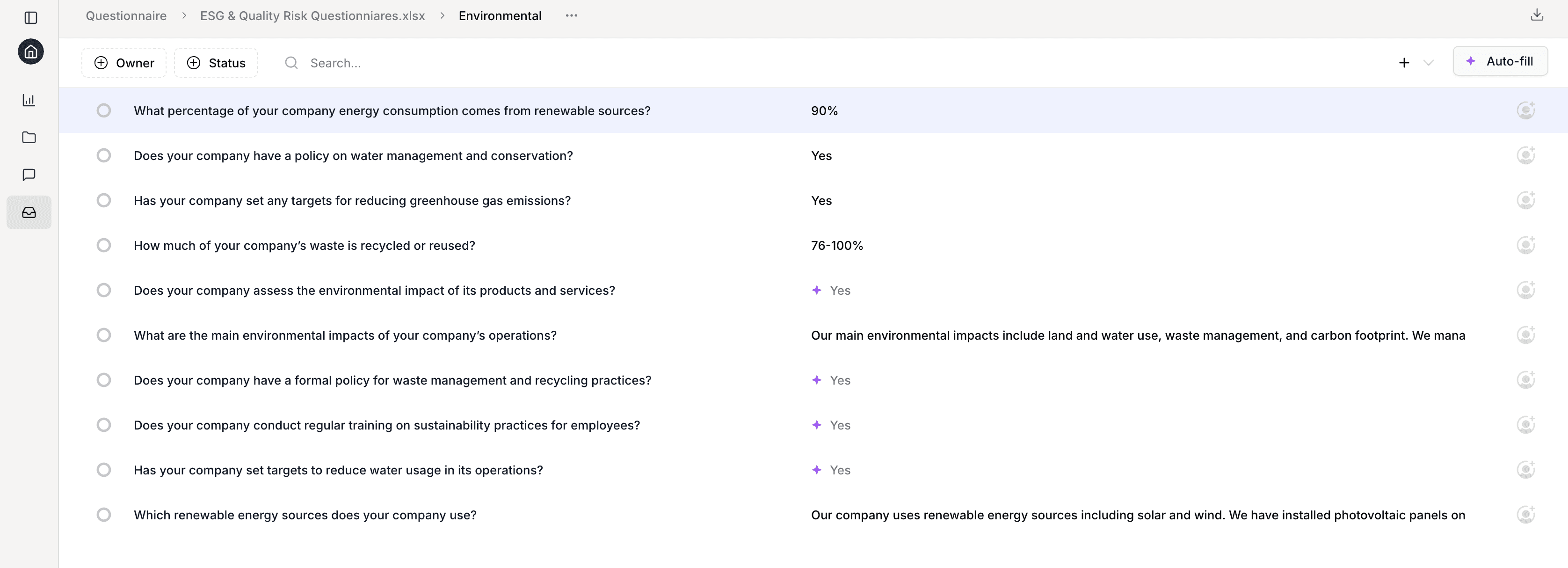
At the heart of Passionfruit’s platform is its powerful automation capability, designed to streamline the entire questionnaire process. Rather than manually reviewing each form and hunting for answers, Passionfruit automatically maps questions to the company’s existing data sources and autofills each questionnaire with the most relevant, verified information. This intelligent matching eliminates repetitive data entry, allowing QA managers to avoid duplicating the same information across multiple forms.
By recognizing patterns and similarities across different questionnaires, Passionfruit significantly reduces the time and effort required to complete compliance requests. This not only speeds up responses but also improves accuracy, freeing quality teams to focus on higher-value tasks instead of tedious form-filling.
Shared Workspaces for Seamless Team Collaboration
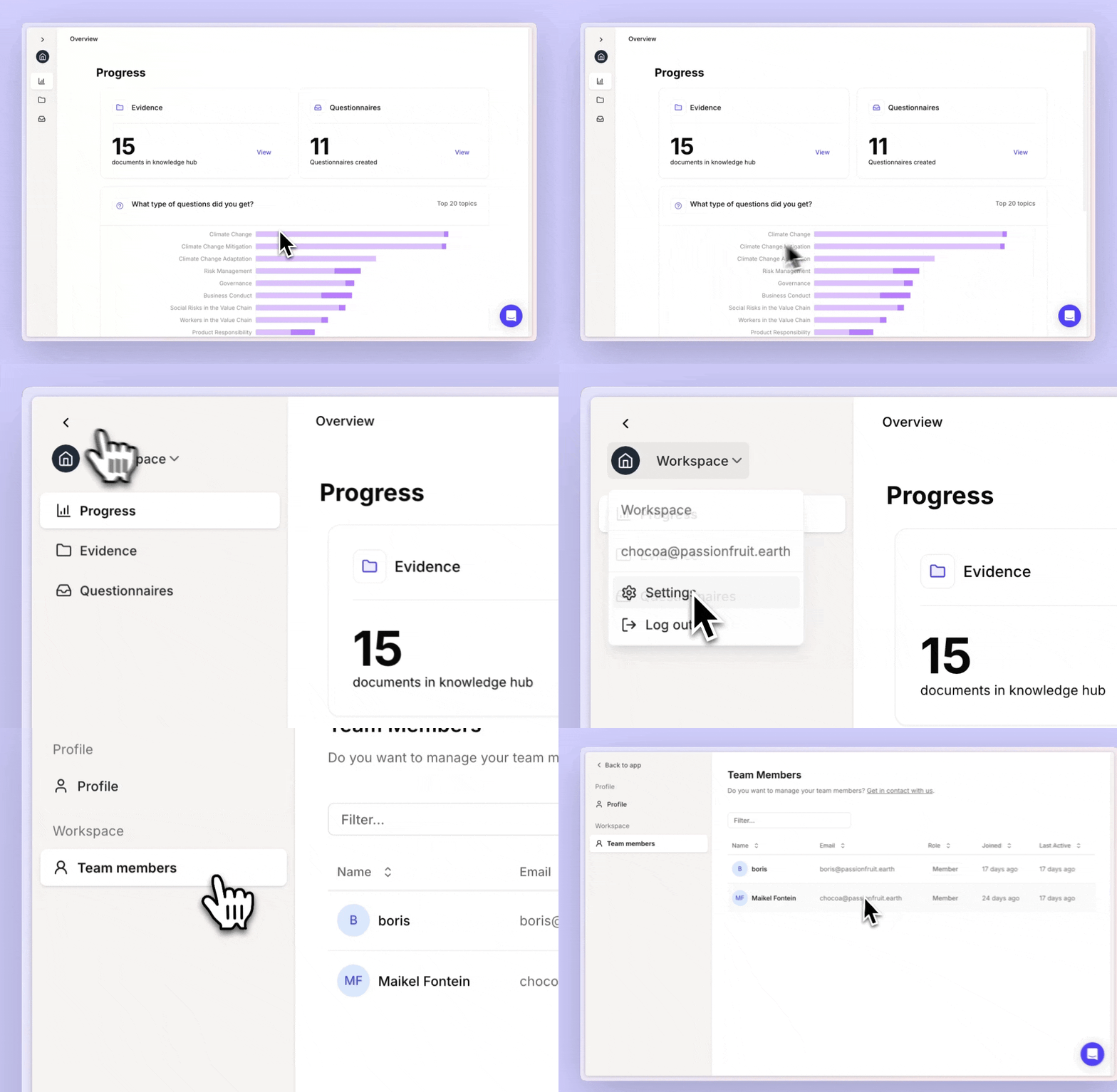
Passionfruit offers shared workspaces designed to bring QA teams, departments, and stakeholders together in one centralized digital environment. These collaborative spaces enable teams to work simultaneously on quality questionnaires, share documents, and track progress in real time all while maintaining full control over data access and permissions.
With shared workspaces, communication silos are broken down, reducing the back-and-forth emails and version conflicts that often slow down quality reporting. Team members across different locations can review, update, and approve responses collaboratively, ensuring transparency and accountability throughout the process.
This unified approach not only speeds up questionnaire completion but also strengthens team alignment, improves data accuracy, and makes audit preparation smoother. Whether it’s a small QA team or a complex multi-site operation, Passionfruit’s shared workspaces empower everyone involved to contribute efficiently and confidently.
Centralized Knowledge Hub for Effortless Access
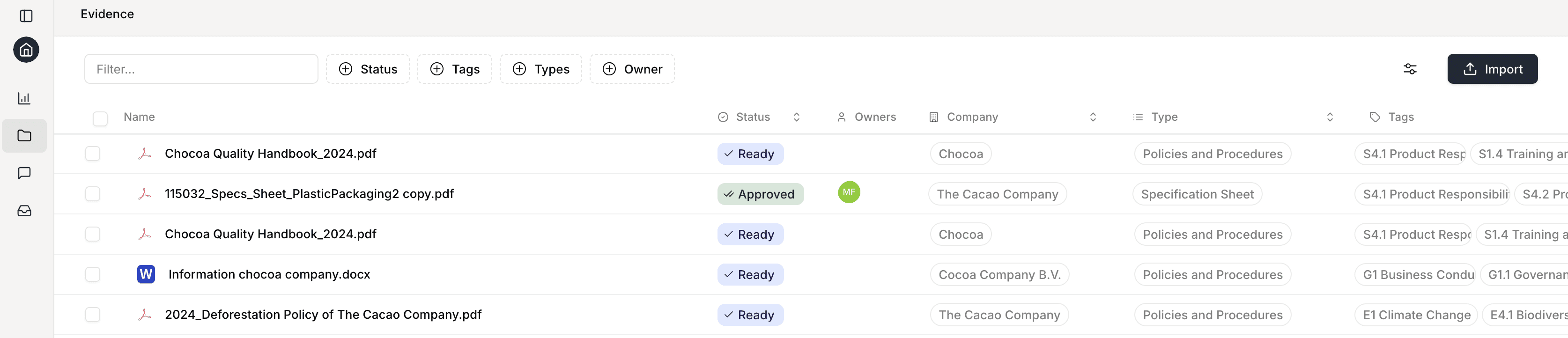
Passionfruit provides a secure, centralized knowledge hub where all your critical quality documents (such audit reports, certifications and more) are stored in one easily accessible location. This unified repository simplifies data management, allowing your team to quickly find and manage verified information without wasting time searching through scattered systems or folders.
By consolidating your quality assets in a single platform, Passionfruit ensures that every questionnaire is completed using accurate, up-to-date, and consistent data, reducing errors and streamlining compliance workflows.
Answer Library: Build and Reuse Verified Responses
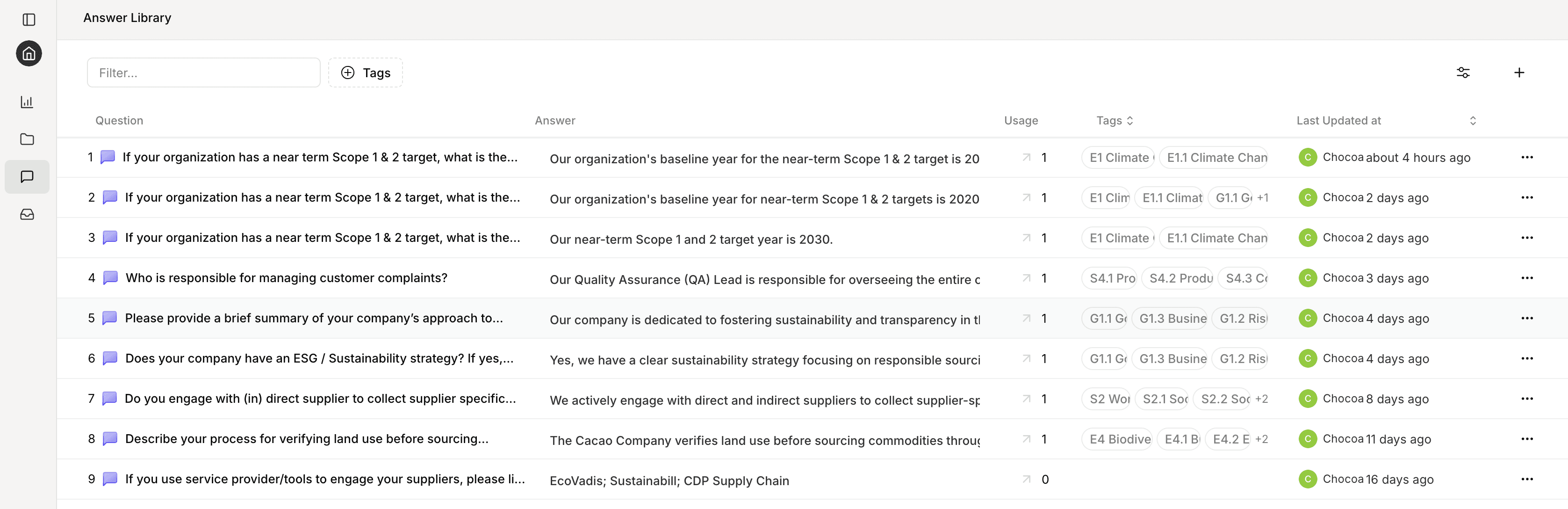
Passionfruit’s Answer Library is a centralized repository where QA teams can store, organize, and manage verified responses to frequently asked questions and common questionnaire items. This feature allows teams to quickly retrieve standardized answers, ensuring consistency and accuracy across all submissions.
By building a robust answer library, organizations can drastically reduce the time spent on repetitive data entry and improve response quality. The library also supports version control and updates, so your team always uses the most current information, making audits and compliance reporting smoother and more reliable.
Integrations with Excel,Word, and more for Seamless Workflow
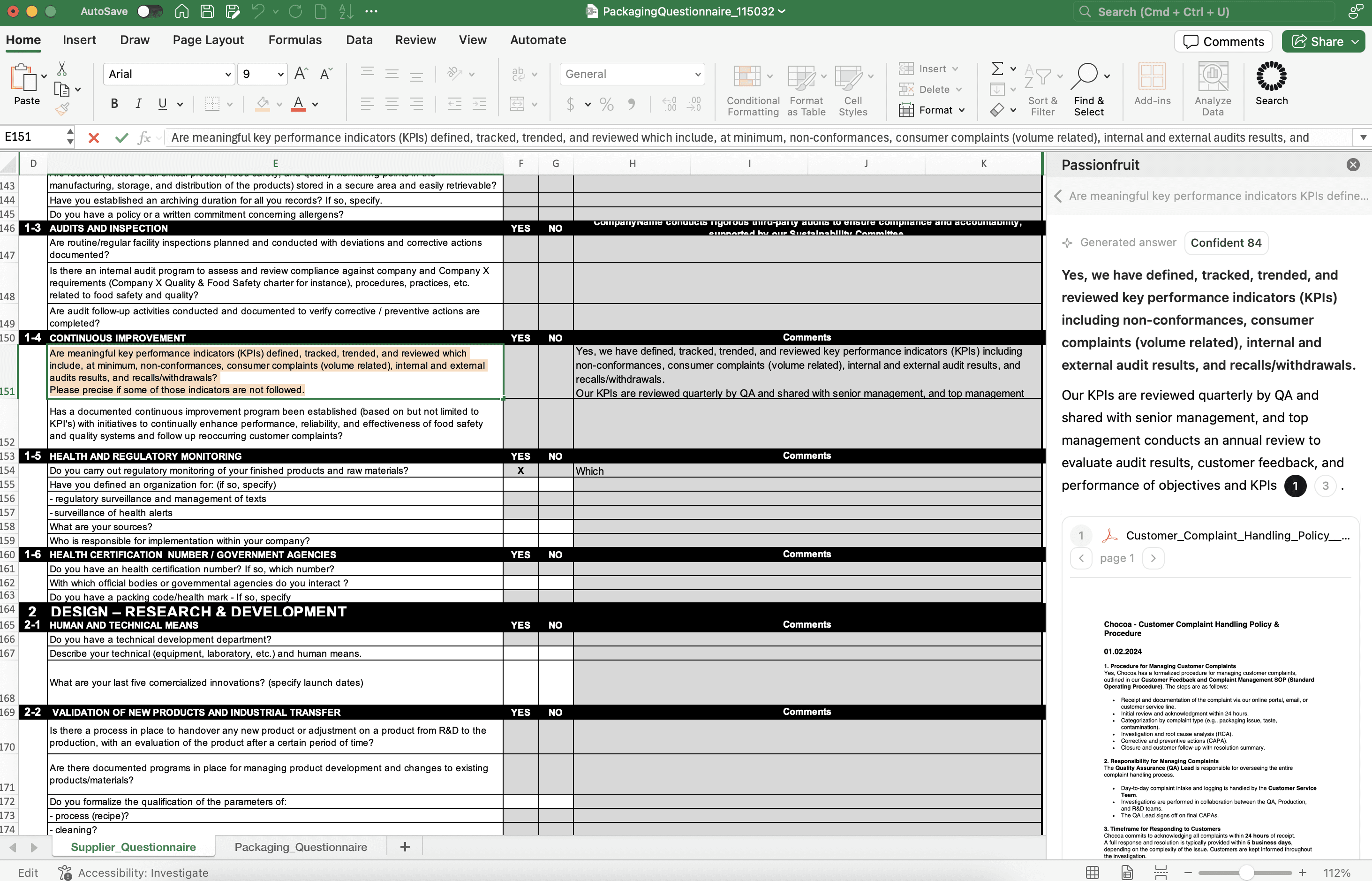
Recognizing that many QA teams rely heavily on Excel, Word, Outlook and more for their day-to-day operations, Passionfruit provides dedicated add-ons for these platforms. These integrations enable users to interact with quality questionnaires directly within the familiar interfaces of Excel and Word allowing them to complete forms, review suggested answers, and submit responses without ever leaving their preferred tools.
By embedding questionnaire workflows into widely used applications, Passionfruit eliminates the need to switch between multiple platforms, significantly reducing disruptions and saving valuable time. This seamless experience accelerates the entire quality reporting process while maintaining accuracy and consistency.
Whether it’s updating data spreadsheets or finalizing reports, these integrations empower QA teams to work efficiently within their existing routines making compliance management smoother and more intuitive.
A Real-World Example: How The Funny Food Factory Streamlined Quality Reporting
The Funny Food Factory, a growing food producer with multiple production sites, was facing a familiar challenge: their QA team was overwhelmed with repetitive, time-consuming questionnaires. With each customer and certification body requesting slightly different data formats, their quality managers spent countless hours manually compiling answers, chasing suppliers for updates, and double-checking documents.
After adopting Passionfruit, Funny Foods Factory experienced a dramatic shift in their quality management process. The platform automated the retrieval of verified data from a centralized knowledge hub, allowing the team to autofill questionnaires accurately and quickly.
This shift reduced response times from several hours to just several minutes, freeing the QA team to focus on meaningful quality improvements instead of paperwork.
Curious to see the full story? Check out the detailed Funny Foods Factory case study.
Why QA Managers Welcome AI as a Game-Changer
For many QA managers, AI isn’t a threat, it’s a powerful ally that transforms how they work. By automating repetitive tasks and streamlining data collection, AI frees up valuable time that can be redirected toward more strategic activities. Instead of spending hours buried in paperwork, QA teams can focus on improving processes, preparing for audits, and driving quality improvements that truly make a difference.
Reducing administrative burdens also helps lower burnout, one of the biggest challenges in quality management. With less time spent chasing data and more time spent on meaningful work, teams feel more engaged and motivated.
Yvette, Quality Manager at Funny Foods Factory, shared how Passionfruit transformed their approach:
"Customers literally called us to ask what we changed. More complete answers, faster turnaround - and internally we spend 75% less time per questionnaire."
This shift not only boosts efficiency but also strengthens compliance, enabling faster, more accurate responses during audits and customer requests.
Closing Thoughts: AI as a Sidekick, Not a Replacement
AI does not replace what QA managers are actually good at. It removes the part of the job that was never a good use of their time to begin with.
The QA managers who are already working with tools like Passionfruit are not doing less work. They are doing different work: less time on questionnaire administration, more time on the quality decisions that actually require their expertise.
If you want to see what that looks like in practice, the Funny Food Factory case study covers the specifics. Or if you are ready to see how it works with your own team's questionnaire volume, book a demo here.