A practical guide for quality, ESG, and compliance teams in food and beverage

Maikel Fontein
9
min

You studied food safety. You spent years building expertise in HACCP, BRC, allergen management, supplier audits. You know what's in the products. You understand the risk. You've kept people safe without anyone in the business noticing.
And yet, somehow, a big chunk of your week is still spent copy-pasting the same allergen table into a new Excel template. Chasing a supplier for a COA that arrived three weeks late. Filling in a 68-question compliance questionnaire that is 80% identical to the one you filled in last Tuesday for a different customer. Writing up the internal audit report from notes you took on a clipboard at 4pm on a Friday.
That's the part that's about to change. Not the expertise. The admin around it.
This is for quality managers, food safety leads, and technical managers hearing more and more about AI who want a straight answer: what does this actually mean for my work?
What is an AI agent, exactly?
An AI agent is software that can take a goal, figure out the steps to achieve it, use the relevant tools and documents along the way, and deliver a result. Without you having to do each step manually.
Think of it this way. A calculator does what you tell it, one operation at a time. An accountant takes a goal ("close the books for Q3") and figures out how to get there: pulling the data, applying the rules, flagging exceptions, producing the output. You review and sign off. The accountant does the work. You make the decisions.
An AI agent works the same way, applied to information-heavy tasks. You give it a goal. It reads the right documents, applies the right logic, fills in the right fields, drafts the right email, and hands you something to review.
In quality, that might look like: "Fill out this incoming supplier questionnaire based on our latest specs, certifications, and policies." Today, that questionnaire sits in your inbox until you find a four-hour window to work through it, question by question, tab by tab. With an agent, you open your inbox not to find work waiting, but to find work finished.
The agent does the work. You make the decisions.
What your Tuesday actually looks like
08:15: Open email. Three new supplier questionnaires came in over the weekend. One is 72 questions in a customer portal you've never logged into before. A retailer wants an updated allergen declaration on four products by end of day. A supplier's organic certificate expired last month, no-one flagged it.
09:30: Production calls. There was a non-conformance yesterday afternoon, a foreign body found downstream of the metal detector. You need to open an incident report, trace the batch, assign corrective actions to the line supervisor, and notify QC. You do it from memory, in a Word template, while someone waits on the phone.
11:00: The BRC pre-assessment is in five weeks. You start pulling together documentation and realise two procedures haven't been reviewed in 14 months. Someone needs to update them, route them for approval, and get them signed before the auditor arrives.
13:30: A new product is in development. R&D needs the HACCP assessment updated to include a new processing step. You draft the revised control measure, figure out who needs to verify what, write three separate emails assigning tasks, and schedule a review meeting.
15:00: A COA arrives from a supplier. The microbiological values are slightly off spec. You compare it against the previous four COAs manually, decide it's a trend, draft a non-conformance notice, and start the batch hold conversation with operations.
16:30: You walk the packaging line for an internal audit. Take notes on a clipboard. Spot two observations. After the walk, you need to write up the report, raise the corrective actions in your system, and assign them with deadlines.
17:45: The 72-question portal questionnaire is still open. You've done eleven questions. You'll finish it tomorrow. Probably Thursday.
Look at that day. Almost all of it is information work, finding the right document, formatting the right answer, assigning the right task, drafting the right email, comparing the right numbers. Almost none of it requires the expertise that took years to build.
That's the target. Not the expertise. The machinery around it.
Where AI agents fit in food quality work
The conversation about AI in food quality usually starts with questionnaires. That's the most visible pain, but it's a narrow view of where the time actually goes.
Supplier questionnaires and compliance responses
A customer sends a 60-question EcoVadis compliance questionnaire. The agent reads it, finds the relevant answers across your product specifications, certifications, and previous responses, and drafts the answers flagging the ones it isn't confident about for your review. You spend 20 minutes reviewing rather than four hours building from scratch. One food ingredients company using this approach cut their average response time from 11 days to under 2. The same logic applies to allergen declarations, technical data sheets, and CSRD-linked customer requests.
COA review and non-conformance flagging
When a certificate of analysis arrives, the agent compares values against your raw material specification, flags any out-of-range results, and drafts the non-conformance notice ready for your review. What was a manual comparison across two documents becomes a two-minute check. One quality team we work with receives 250+ COAs per year. That's 250 comparisons that no longer require human attention to initiate.
Supplier documentation tracking
Certificates expire. Suppliers forget to send updates. You discover the gap when an auditor asks for it. An agent monitors expiry dates across your supplier list, sends renewal requests automatically, tracks what's come back, and escalates what hasn't. No colour-coded spreadsheet. No Monday morning check ritual.
The other use cases (incident reports, internal audit prep, HACCP plan updates, supplier onboarding, policy review) follow the same pattern. Information work that currently requires a human to initiate, locate, format, and send. Agents handle the initiation. You handle the judgment.
The food quality work AI cannot automate
Walking the floor
No agent audits a production environment. The observation that tells you something is off (the smell, the way the team is moving, the seal that doesn't look quite right) comes from being there. Permanently human.
Making risk decisions
Whether to accept a borderline batch. Whether a non-conformance is correctable or critical. Whether to approve a supplier with a weak traceability plan but a strong track record. These calls carry consequences and require full context. They stay with the person who understands the situation and carries the responsibility.
Building food safety culture
The reason your HACCP system works isn't the documentation. It's the behaviour of the people on your site. Building that culture is the most important part of quality leadership. No agent does it.
Supplier relationships
The factory visit that reveals what the paperwork can't. The relationship that means they call you before shipping a questionable batch, not after.
Cross-functional influence
Getting procurement to understand why the cheapest ingredient isn't always the right one. Convincing operations that a CCP modification needs proper validation before it goes live. An agent can prepare the briefing. It can't do the influencing.
One more thing worth naming
General AI tools like ChatGPT cannot do this work reliably. When a quality manager pastes in a supplier questionnaire, they get back confident, well-written answers that have nothing to do with their actual products. The tool has no knowledge of your specs, your certifications, or your processes. The difference isn't the AI. It's the workflow built around it and a general tool has none of yours.
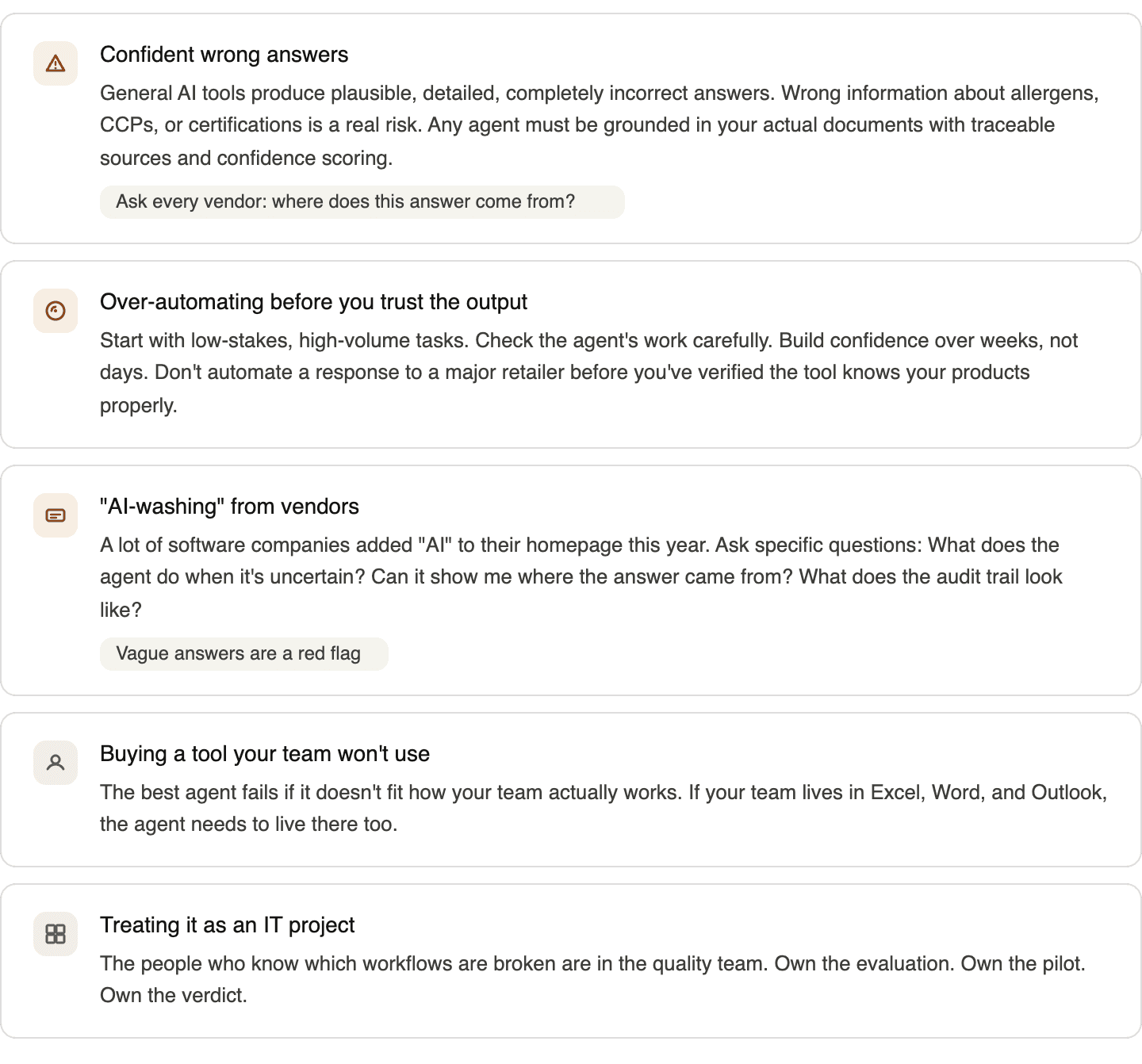
Common mistakes when adopting AI in food quality
Introducing AI to your quality team: how to frame it
The right framing is simple: we're not changing what you do. We're changing what takes up your time.
→ We're automating the repetitive parts of the job. Not the expertise. Not the decisions. The parts you could do in your sleep.
→ Nothing goes out without a human reviewing it. The agent drafts; you decide.
→ The goal is that you spend more time on work that actually needs you: the floor, the audits, the decisions that matter.
→ We move at a pace that lets the team build confidence in the tool. No surprises.
Making the business case for AI in food quality to leadership
→ This is a risk issue, not just a cost issue. A quality team under administrative overload misses things expired certificates, delayed NCR closures, inconsistent answers to the same customer question. Agents reduce the gaps, not just the hours.
→ The competitive picture is shifting. Suppliers who respond faster and more accurately to compliance requests are winning preferred supplier status. This affects commercial relationships.
→ The budget logic is straightforward. Don't hire a third person to handle growing admin volume. Give two people tools that make them three times as effective.
→ This isn't an IT project. The tools that work for quality teams fit inside email, Excel, SharePoint. No infrastructure changes. A quality operations decision, not a technology decision.
→ We want to pilot first. One workflow. One team. One month. We measure time saved and output quality. Then we decide based on evidence, not assumptions.
Where to start
Track your own time for one week. Every time you do something repetitive, something where the right answer exists somewhere in your files but finding and formatting it takes time, note it. By Friday you'll have a shortlist.
Start with the highest-volume, lowest-risk tasks. Supplier questionnaires, certificate expiry chasing, COA comparison, non-conformance report drafting. Tasks where you can check the output easily before it goes anywhere important.
Look for tools built for food, not general enterprise. The regulatory context matters: BRC, FSSC 22000, IFS, HACCP, allergen frameworks. A generic tool doesn't know your products, your specs, or your certifications.
Run a pilot, not a procurement process. One workflow, one willing team member, four weeks. Let the results make the case.
A note on evaluating AI tools for food quality
When assessing any platform, ask for a live demonstration using your actual documents not a demo dataset. The value of an AI agent in food quality is entirely determined by what it knows about your specific products, specifications, and certifications. Generic demos tell you nothing useful.
What this means for quality teams over the next five years
Every generation of quality professionals has faced a moment when the tools caught up with the workload. Paper to spreadsheets. Shared drives to QMS software. Remote audits. Each time, the shift wasn't about replacing expertise. It was about what you did with your time once you stopped doing things the slow way.
This is that moment again. The volume of information work in food quality is genuinely too high to keep handling the way it's been handled.
The quality managers who will do best over the next five years are not the ones who know the most about AI. They're the ones who are clear about what their expertise is worth, and confident enough to hand the routine tasks off so they can stay focused on the work that actually requires them.
That expertise isn't going anywhere.
The inbox is.