A workflow guide for food and beverage suppliers managing EcoVadis assessment. We cover team ownership, document strategy, answer reuse, and a four-week submission process that holds up under deadline pressure.

Maikel Fontein
9 min
min

The EcoVadis assessment window opens and suddenly three departments are copying last year's answers into a shared drive, someone is chasing the EHS team for updated emissions data, and the ESG Manager is wondering why a process they have been through four times still feels like the first time.
The suppliers that handle it well do not work harder during the submission window. They have built a process that runs before it opens. This guide covers what that looks like, from dividing ownership across the right people to managing the 55-document limit without wasting a single upload.
If you manage broader customer compliance workflows beyond EcoVadis, the same principles apply here too.
Why the EcoVadis questionnaire becomes a scramble even for experienced teams
The answers from last year exist somewhere. The documents are filed somewhere. But that knowledge lives in email threads, personal drives, and the memory of whoever ran it last time. When the assessment window opens, the team reconstructs rather than retrieves.
The second reason is ownership. EcoVadis covers four themes and each draws on data from different parts of the business. Without defined ownership before the window opens, the ESG Manager ends up chasing every department, often with two weeks left on the clock.
The third reason is document strategy. The 55-document limit sounds generous until uploading the wrong files, duplicating evidence, or submitting outdated documents wastes slots that could have strengthened a weaker theme.
These are process problems, and they have process solutions.
What does the EcoVadis submission timeline actually look like for food suppliers?
Understanding the full timeline, not just the submission deadline, is the first step to running EcoVadis without a scramble.
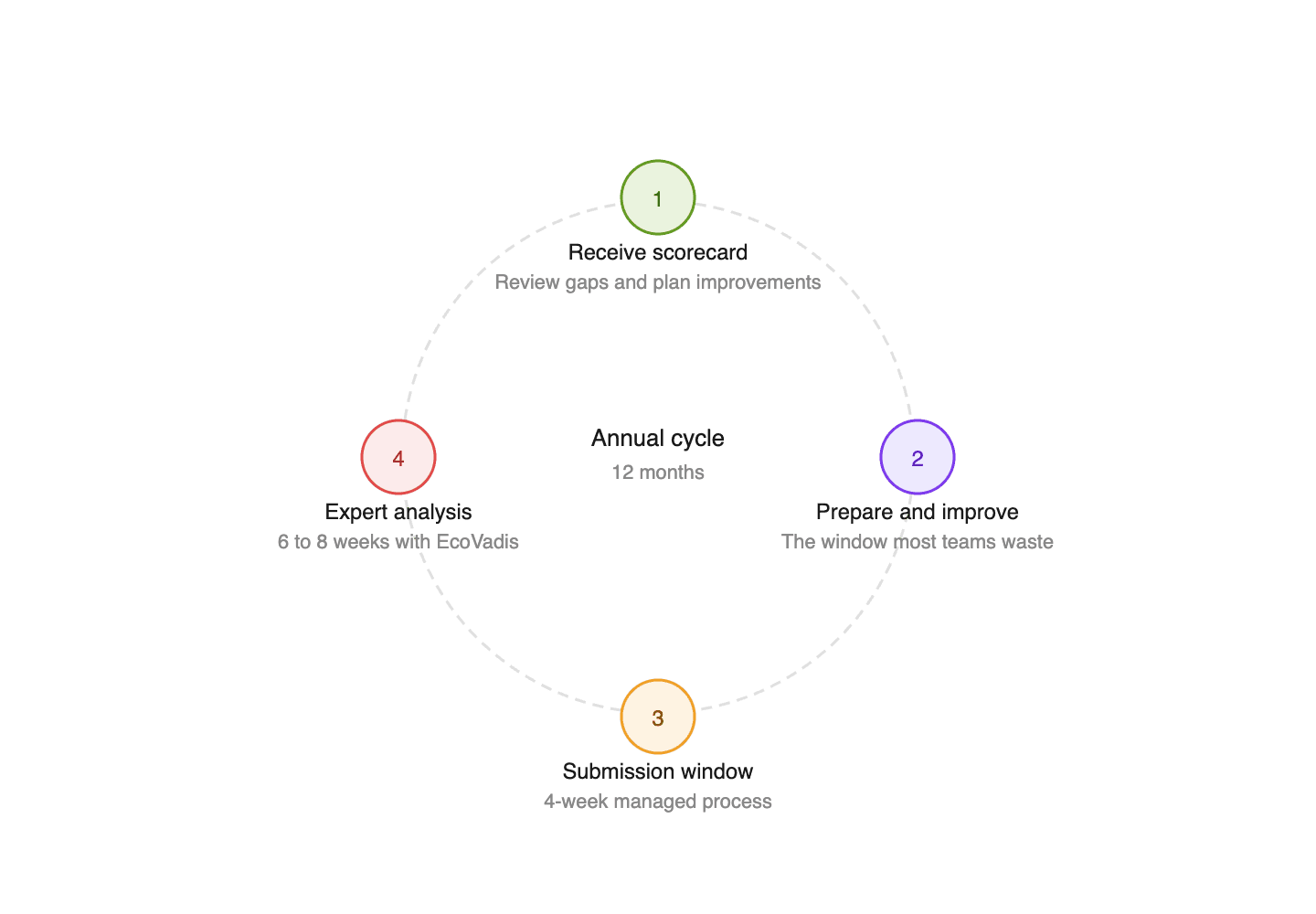
Your EcoVadis scorecard is valid for 12 months. Once you submit, the expert analysis phase takes six to eight weeks before you receive your results, making the full cycle two to four months. The practical implication is that preparation should start eight to ten weeks before your submission deadline, not when the window opens. Here is what that looks like:
Eight to ten weeks before deadline: Review last year's scorecard. Identify the gaps EcoVadis flagged. Assign owners to each of the four themes. Flag any documents that have expired or policies that have been updated since the last submission.
Five to seven weeks before deadline: Owners begin gathering updated evidence for their themes. New or updated policies are drafted and approved. Missing data points are requested from the relevant departments.
Three to four weeks before deadline: Internal review of draft answers and documents. Cross-check for consistency across themes. Finalise document selection against the 55-document limit.
One to two weeks before deadline: Final approval and sign-off. Submit. Record the submission date and version of each document uploaded.
Teams that follow this structure submit on time with consistent, verified answers. Teams that start when the window opens submit under pressure with whatever they can find.
Who should own each part of the EcoVadis questionnaire in a food supplier team?
EcoVadis covers four themes and no single person in a food supplier organisation owns all of them. Trying to run the assessment through one person, typically the ESG Manager or Quality Manager, is the most common reason it becomes a bottleneck.
A practical ownership model for a mid-size food and beverage manufacturer looks like this:
Environment covers energy consumption, greenhouse gas emissions, water use, waste management, and biodiversity. This theme is owned by the EHS or sustainability lead, with input from site operations for energy and water data. If you have an annual sustainability report or CDP submission, much of this data already exists.
Labour and human rights covers health and safety, working conditions, employee development, and human rights across your operations and supply chain. This theme is owned by HR for the people and training elements, and by the QA or EHS lead for health and safety documentation. SMETA audit reports and health and safety management system certifications are key evidence here.
Ethics covers anti-corruption, anti-competitive behaviour, and information security. This theme is owned by legal or compliance. For most food suppliers this is the lightest theme in terms of documentation requirements, but the anti-corruption policy and whistleblower mechanism need to be current and explicitly scoped to the business.
Sustainable procurement covers how you manage sustainability risks in your own supply chain. This theme is owned by procurement or the ESG lead, with input from quality on supplier approval processes. Your supplier code of conduct, supplier assessment procedures, and any evidence of supplier audits belong here.
One person should act as the overall coordinator, typically the ESG Manager or whoever has run the assessment before. Their role is to manage the timeline, chase owners for missing evidence, and ensure consistency across the full submission before it goes in. They are not responsible for generating the content in every theme. That distinction matters.
How to reuse last year's EcoVadis answers without repeating last year's mistakes
Reusing last year's answers is not inherently wrong. Most of your policies, processes, and data points will not have changed dramatically in twelve months. The problem is reusing answers without checking whether they are still accurate, still supported by current documents, and still reflecting what EcoVadis wants to see.
Three things to check before reusing any answer from last year:
Has the underlying practice or policy changed?
A health and safety answer that references your OHSAS 18001 certification is a problem if you transitioned to ISO 45001 in the intervening year. An emissions answer that uses 2023 data is a problem if EcoVadis expects the most recent reporting year. Go through each answer and confirm that what it describes still reflects current reality.
Is the supporting document still valid?
EcoVadis analysts check that uploaded documents match what the answers claim. A policy document that predates a major revision, a certification that has lapsed, or a supplier audit report from three years ago will undermine an otherwise strong answer.
Did EcoVadis flag this answer last year?
Your scorecard includes feedback on where evidence was insufficient, where answers were inconsistent, or where topics were underscored. Reusing an answer that EcoVadis already told you was weak is the most avoidable way to repeat a low score.
A reuse register that maps each answer to its supporting document, the last date it was reviewed, and any EcoVadis feedback from the previous cycle makes this check systematic rather than reliant on memory.
Making the 55-document limit work for you
EcoVadis allows a maximum of 55 documents per submission. For teams that approach this without a strategy, 55 slots disappear quickly and not always on the evidence that matters most.
A few principles that make the limit work in your favour rather than against you:
One document can support multiple themes | Your sustainability report, if it covers environment, labour, and supply chain practices, can be linked to questions across three themes. You do not need to upload separate documents for every question it answers. EcoVadis analysts read documents in full and will credit relevant content across themes. |
Prioritise evidence for your weakest themes | If your environment score was strong last year and your sustainable procurement score was weak, allocate more document slots to procurement evidence. Uploading additional environment documents when that theme is already well-evidenced does not improve your score. |
Current beats comprehensive | A recent supplier audit report covering ten suppliers is more valuable than a comprehensive supplier code of conduct from four years ago. EcoVadis weights recent evidence of implementation over older statements of policy. When you have a choice between a current document and a more comprehensive older one, choose currency. |
Remove documents that no longer apply | If a certification has lapsed, a policy has been superseded, or a document covers a site that is no longer in scope, do not carry it forward. Outdated documents create inconsistencies that analysts flag and that can reduce rather than support your score. |
Name documents clearly | EcoVadis analysts review documents manually. A file named "Policy_v3_FINAL_USE THIS" tells them nothing. A file named "Environmental Policy 2025 - Passionfruit BV" tells them exactly what it is and that it is current. |
A four-week EcoVadis submission workflow that holds up under pressure
With ownership defined and a reuse register in place, the four weeks before your submission deadline become a managed process rather than a reactive scramble.
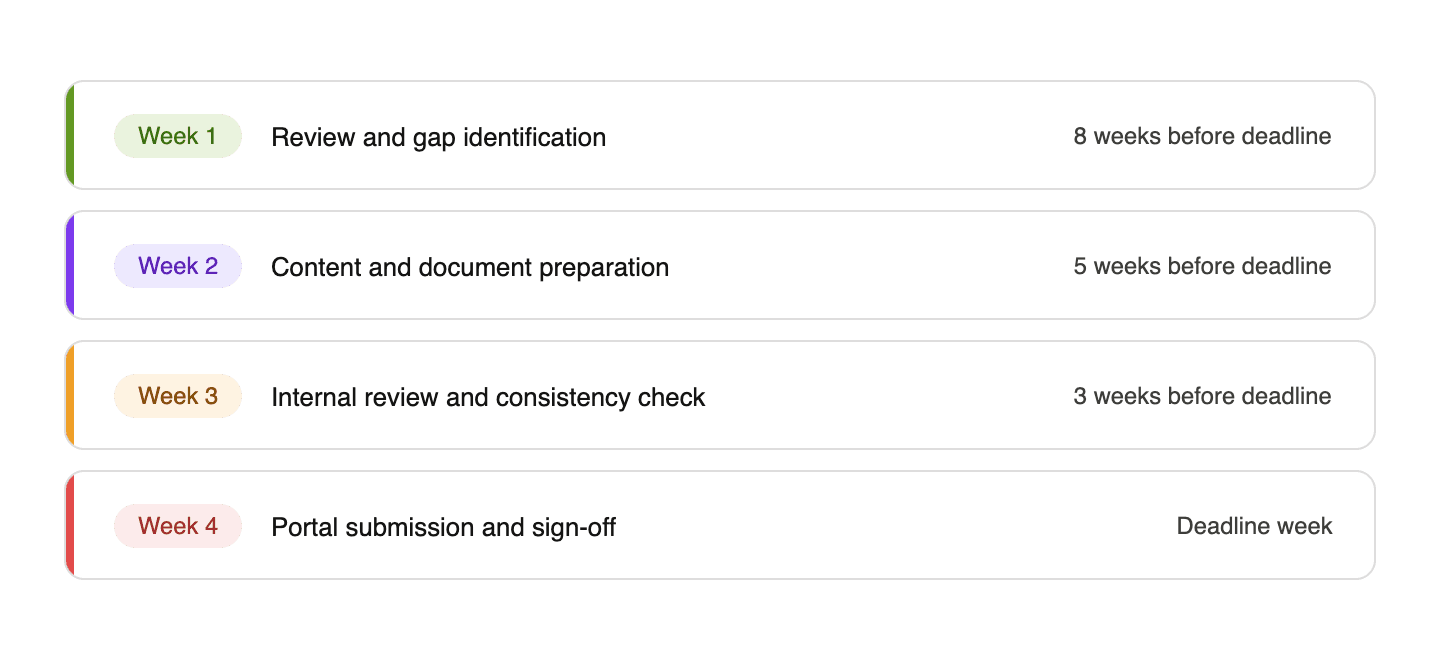
Week 1: Review and gap identification The coordinator reviews last year's scorecard with each theme owner. Gaps flagged by EcoVadis are prioritised. Each owner confirms which answers can be reused, which need updating, and which documents need replacing or renewing. A shared tracker is set up with every question assigned to an owner and a status column.
Week 2: Content and document preparation Owners draft updated answers and gather supporting documents. New or revised policies go through internal approval. Missing data points, emissions figures, training records, supplier audit results, are requested from the relevant departments with a clear internal deadline.
Week 3: Internal review and consistency check The coordinator reviews all answers and documents before they go into the portal. Cross-theme consistency is checked: if the environment theme references a specific GHG emissions figure, the same figure should appear in any sustainability report uploaded as supporting evidence. Document names are standardised. The 55-slot allocation is finalised.
Week 4: Portal submission and sign-off Answers are entered into the EcoVadis portal. Documents are uploaded against the correct questions. A named approver confirms the full submission before it is sent. The submission date, document versions, and any EcoVadis reference numbers are recorded. The coordinator notes any gaps or improvements to address before the next cycle.
What are the key benefits of a structured EcoVadis questionnaire workflow for food suppliers?
Consistent scores year on year. A structured process that reuses verified answers and addresses flagged gaps systematically produces more consistent results than a reactive approach that varies by who ran it and what they could find.
Less time spent per submission. Teams that build a reuse register and define ownership before the window opens report significantly less time spent on each subsequent assessment because the work compounds rather than restarts.
Fewer last-minute document requests. When theme owners know what they are responsible for eight weeks out, they gather evidence at their own pace rather than responding to urgent requests from the ESG Manager in the final week.
A stronger document strategy. Conscious allocation of the 55-document limit towards weaker themes and current evidence produces better scorecard outcomes than uploading whatever is available.
A process that transfers. When the person who ran EcoVadis last year leaves, a documented workflow with a reuse register and defined ownership means the next person is not starting from zero.
Checklist: before you submit your EcoVadis questionnaire
Answers |
|---|
✔ Every answer has been reviewed against last year's submission and updated where practices, data, or certifications have changed |
✔EcoVadis feedback from last year's scorecard has been addressed in the relevant answers |
✔ No answer references a policy, certification, or process that is no longer current |
✔ Answers across themes are consistent with each other and with the documents uploaded |
Documents |
|---|
✔ Every uploaded document is current and within its validity period |
✔ Documents are named clearly with the document type, year, and entity name |
✔ No duplicate documents are uploaded across themes where one document covers both |
✔ The 55-document limit has been allocated strategically, with more slots given to weaker themes |
✔ Documents from the previous submission that are no longer valid have been removed |
Process |
|---|
✔ A named approver has reviewed the full submission before it goes in |
✔ The submission date and document versions have been recorded |
✔ Any gaps that could not be addressed this cycle have been noted for next year |
✔ Theme owners have been informed of the submission and any feedback they should expect |
Conclusion
EcoVadis is one of the most structured customer compliance requests food suppliers receive. It is also one of the most repeatable, which means the investment in building a proper workflow pays back across every subsequent cycle.
The four things worth remembering:
The scramble happens because knowledge from last year is not carried forward systematically. A reuse register and defined ownership fix that before the window opens.
EcoVadis covers four themes that belong to four different parts of your business. One coordinator, four theme owners, and a shared tracker is the minimum viable structure.
The 55-document limit is a strategic resource. Allocate it deliberately, prioritise current evidence, and remove anything that no longer applies.
A four-week internal workflow that separates preparation from submission means the deadline becomes a distribution task, not a problem-solving exercise.
EcoVadis is one of many customer compliance requests Passionfruit was built to handle. It works on top of your existing documents, matches incoming questions to your approved answers, and manages the approval workflow so your team spends less time reconstructing and more time reviewing. Book a demo here to see what that looks like with your actual EcoVadis workflow.