This guide covers how Quality and Sustainability teams at food and beverage suppliers can respond to ESG questionnaires together, with shared ownership, consistent answers, and a joint approval workflow.

Maikel Fontein
9 min
min

A customer sends an ESG questionnaire. The ESG coordinator splits it up: food safety and certification questions go to Quality, emissions and environmental questions go to Sustainability. Both teams answer their sections. The responses go out. Three weeks later the customer's technical team flags that the water usage figure in the environmental section does not match the water management statement in the food safety section. Neither team knew the other had addressed it.
This is what happens when two teams with different data, different language, and different priorities respond to the same questionnaire without a shared system connecting them.
If you manage ESG questionnaire responses at a food or beverage manufacturer and you are not the only person who needs to be involved, this guide is for you. It covers where the coordination breaks down, how to build a system that prevents it, and what a coherent joint response process looks like in practice.
Why ESG questionnaires expose the gap between Quality and Sustainability every time
Most food suppliers have separate Quality and Sustainability functions. Quality owns food safety systems, certifications, allergen management, and audit documentation. Sustainability owns emissions data, environmental policies, ethical sourcing, and ESG reporting. In day-to-day operations, the two teams rarely need to produce a single shared output.
ESG questionnaires change that. A customer qualification questionnaire or an EcoVadis assessment does not respect the boundaries between functions. It asks about FSSC 22000 certification and greenhouse gas emissions in the same submission. It asks about HACCP documentation and human rights policies in the same document. It asks about allergen controls and water consumption targets in the same portal.
Every ESG questionnaire ends up as a deadline that lands on multiple desks at once with no clear owner. The coordinator scrambles. Deadlines slip. And the answers that come back from two separate teams frequently do not tell a consistent story.
What does a typical ESG questionnaire ask Quality teams versus Sustainability teams?
Quality-owned questions typically cover:
Food safety management system and certifications (FSSC 22000, BRCGS, IFS)
HACCP documentation and critical control points
Allergen management procedures and risk assessments
Traceability systems and mock recall performance
Internal and third-party audit results
Corrective action and non-conformance management
Supplier approval and qualification processes for food safety
Sustainability-owned questions typically cover:
Greenhouse gas emissions (Scope 1, 2, and where available, Scope 3)
Energy and water consumption data
Waste management and reduction targets
Environmental policy and certifications (ISO 14001)
Human rights and labour practices across the supply chain
Ethical sourcing policies and supplier code of conduct
CSRD and ESG reporting frameworks
The questions that belong to both are where most coordination failures happen:
Supplier management: Quality owns food safety supplier approval, Sustainability owns ethical sourcing supplier assessments. Both are asked in the same questionnaire section.
Health and safety: Quality often owns operational H&S documentation, HR or Sustainability owns the policy and workforce data.
Traceability and supply chain transparency: Quality owns the food traceability system, Sustainability owns the broader supply chain mapping for ESG purposes.
Water management: Quality may manage water as a food safety parameter (cleaning validation, CIP), Sustainability manages it as an environmental metric. Two teams, one question.
If nobody maps this overlap before the questionnaire arrives, both teams answer the parts they recognise and the overlapping questions either get answered twice with different information or not answered at all.
The inconsistencies that surface when Quality and Sustainability work in isolation
The ESG coordinator splits the questionnaire and sends each section to the relevant team. Quality answers the food safety sections. Sustainability answers the environmental and ESG sections. Both work independently. The coordinator assembles the two halves and submits. What neither team checked: whether their answers reference the same documents.
Quality describes the supplier approval process as a two-stage qualification with an annual review. Sustainability describes the supplier assessment process as an annual questionnaire-based evaluation. To the team, these describe the same process from different angles. To the customer reading both sections side by side, they look like two different processes.
Quality references the 2024 water management procedure in the allergen cleaning validation section. Sustainability uses 2023 water consumption data in the environmental section. The procedure was updated in early 2024 to reflect a process change that reduced water usage. The environmental data does not reflect that change. The customer's technical team notices the discrepancy.
Building a shared ESG response system that works for both teams
A single ownership map for every question type
Before the next ESG questionnaire arrives, map every recurring question type to a named owner. Not a team, a person. Quality Manager owns food safety certifications. EHS Lead owns environmental data. HR owns workforce and labour practice questions. ESG Coordinator owns the ethical sourcing and policy sections. Procurement owns supplier code of conduct evidence.
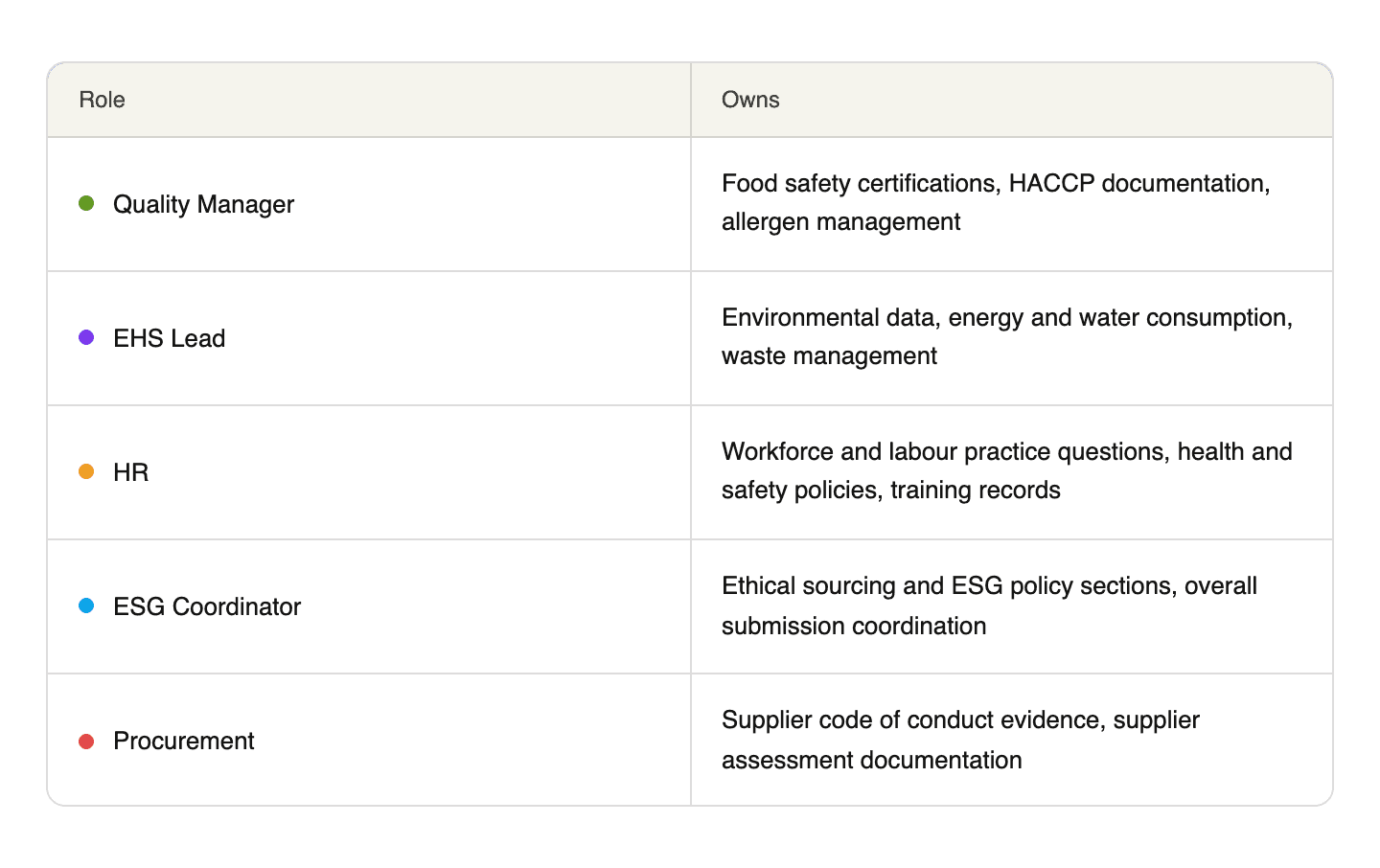
Start with the question types that appear in every questionnaire and build from there.
A shared answer library with cross-team visibility
Quality and Sustainability need to be working from the same documents. When Quality updates the allergen management procedure, Sustainability needs to know. When Sustainability updates the emissions data, Quality needs to know if any of their answers reference it.
A shared answer library that both teams can access and update, with version control and expiry signals for time-sensitive data, prevents two teams from working from different versions of the same underlying information. A shared document with clear sections, named owners, and a last-reviewed date covers the essentials.
Defined overlap questions with joint ownership
For the question types that sit across both functions, supplier management, health and safety, water management, traceability, assign a primary owner and a reviewer from the other team. The primary owner drafts the answer. The reviewer confirms it is consistent with their own data before it goes into the submission. This is a two-minute check that prevents the most common inconsistencies.
What does a joint ESG questionnaire approval workflow look like in practice?
A joint approval workflow means the right people review the right sections, in the right order, before the submission goes out.
Step 1: Coordinator assigns sections to owners When the questionnaire arrives, the coordinator maps each section to the relevant owner using the ownership map. Overlap questions are assigned a primary owner and a reviewer. Internal deadlines are set, typically five to seven days before the customer deadline.
Step 2: Owners complete their sections Each owner completes their assigned questions from the shared answer library, updating where the current submission requires something new. They flag any questions they cannot answer confidently so the coordinator can escalate.
Step 3: Cross-team consistency review Before the coordinator assembles the full submission, both teams review the overlap sections together. A shared document with comments and a thirty-minute call to resolve discrepancies is enough for most questionnaires.
Step 4: Coordinator assembles and reviews the full submission The coordinator reads the complete submission as the customer will read it, looking for contradictions across sections, inconsistent data references, and any answers that make claims not supported by an attached document.
Step 5: Named approver signs off before submission A senior person from each function confirms the submission is accurate before it goes out. The approval is recorded with the approver's name and date.
A realistic scenario: one ESG questionnaire, two teams, one coherent response
A beverage ingredients manufacturer receives a comprehensive supplier qualification questionnaire from a major retail customer. The questionnaire covers food safety certifications, allergen management, environmental performance, supply chain labour practices, and ethical sourcing. Three-week deadline.
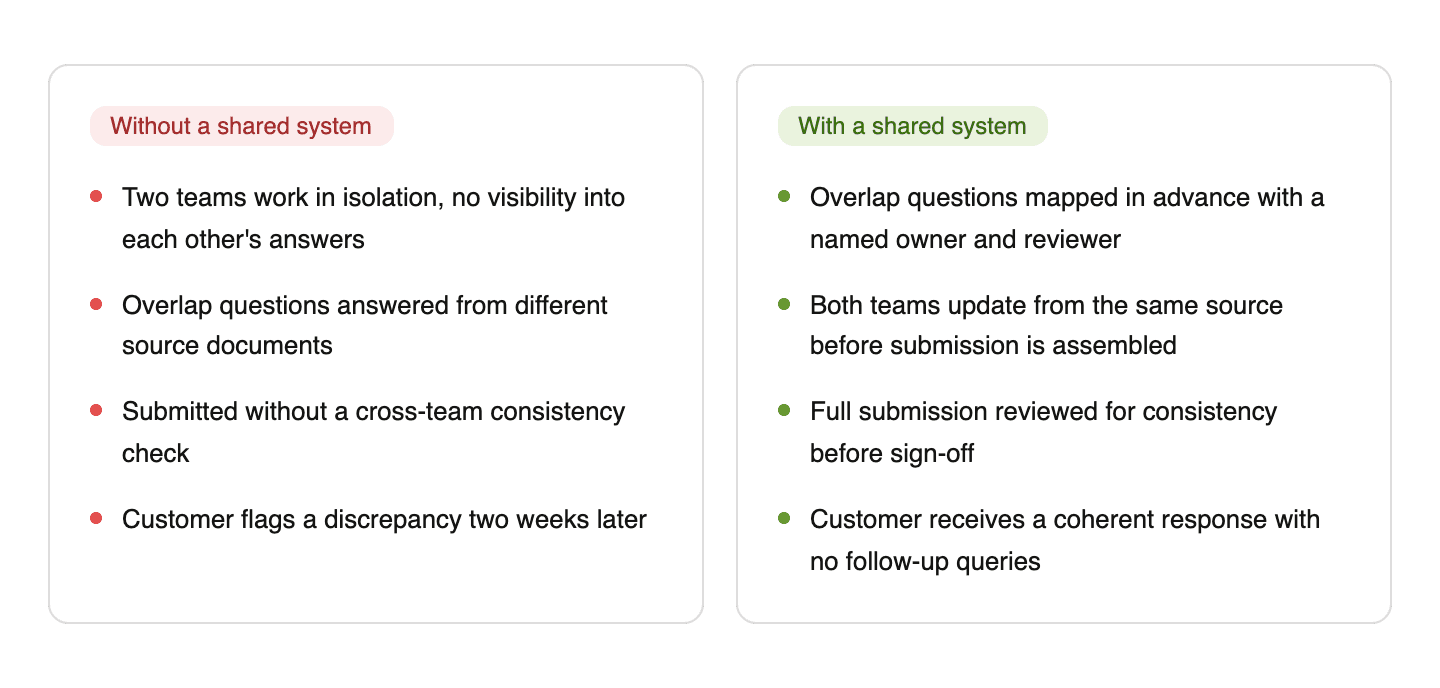
Without a shared system: The ESG Coordinator splits the questionnaire. The Quality Manager references the supplier approval procedure updated in Q1. The Sustainability Lead references the supplier code of conduct from the previous year, unaware the Q1 update also included new supplier sustainability requirements. The coordinator assembles both halves and submits. Two weeks later the customer flags that the supplier management answers in the food safety and ESG sections describe different approval criteria. The coordinator cannot explain the discrepancy without going back to both teams.
With a shared system: The ownership map identifies supplier management as an overlap question. The Quality Manager is the primary owner, the Sustainability Lead reviews for consistency. When the Quality Manager drafts the answer using the Q1-updated procedure, the Sustainability Lead immediately sees that the supplier code of conduct needs updating to reflect the same changes. Both sections are updated from the same source. The coordinator reviews the full submission, a named approver from each team signs off, and the customer receives a coherent response with no discrepancies.
What are the key benefits of Quality and Sustainability collaboration on ESG questionnaires?
Fewer customer follow-up queries. When both teams work from the same answer library and review overlap sections together, inconsistencies are caught internally rather than flagged by the customer after submission.
Faster response times. Defined ownership and a shared system mean the coordinator is assembling a response rather than chasing two teams simultaneously under deadline pressure.
A single source of truth for both functions. A shared answer library gives the whole organisation better visibility into what has been shared with customers and when it was last verified.
Stronger scores on structured assessments. EcoVadis and similar platforms score consistency across themes. Answers that tell a coherent story across food safety, environmental, and ethical sourcing sections perform better than individually accurate but collectively inconsistent ones.
A process that compounds over time. The first joint submission takes effort to coordinate. Each subsequent one takes less, because the ownership map, the shared library, and the approval workflow are already in place.
Checklist: before a joint ESG questionnaire response goes out
Ownership and coordination |
|---|
✔ Every question section has a named owner from the relevant team |
✔ Overlap questions have a primary owner and a reviewer from the other team |
✔ Internal deadlines were set at least five days before the customer deadline |
✔ Both teams have reviewed the overlap sections together before final assembly |
Content and consistency |
|---|
✔ All answers reference current policies, certifications, and data points |
✔ No answer in the food safety sections contradicts an answer in the environmental or ESG sections |
✔ Supplier management is described consistently across Quality and Sustainability sections |
✔ All data points reference the same reporting year and the same source documents |
✔ Every claim is supported by an attached or referenced document |
Approval and submission |
|---|
✔ A named approver from each function has reviewed and confirmed their sections |
✔ The coordinator has read the full submission as a single document before submitting |
✔ The submission date and document versions are recorded in the shared answer library |
✔ Any gaps or inconsistencies that could not be resolved this cycle are noted for next time |
Conclusion
ESG questionnaires will not get simpler. The questions are getting more detailed, the evidence requirements are getting stricter, and the volume of requests is increasing. For food suppliers managing both Quality and Sustainability functions, the only sustainable response is a shared system that makes cross-team coordination the default rather than the exception.
The four things worth remembering:
ESG questionnaires require input from Quality and Sustainability simultaneously. Treating them as a one-team job is where most coordination failures start.
The questions that sit across both functions, supplier management, water, health and safety, traceability, are where inconsistencies are most likely to surface. Map these explicitly and assign joint ownership before the next questionnaire arrives.
A shared answer library that both teams can see and update prevents two teams from working from different versions of the same underlying information.
A joint approval workflow means the right people review the right sections in the right order before anything goes out.
Passionfruit is built for exactly this kind of cross-team coordination. It gives Quality and Sustainability teams a shared answer library, defined ownership per question type, and an approval workflow that routes the right sections to the right reviewers before any response leaves the building. Book a demo here to see what that looks like with your actual team structure.