How food suppliers can build a reusable answer library and approval workflow to handle EcoVadis, SEDEX, and retailer questionnaires without starting from scratch.

Maikel Fontein
8
min
You receive a supplier qualification questionnaire on a Tuesday. 60 questions, 2-week deadline. You open last year's response, realise the allergen management policy it references was updated in Q1, and spend the next hour trying to find the new version.
By Thursday you are chasing the EHS team for water usage figures that should exist somewhere but nobody compiled. By the following Tuesday you are sending an incomplete draft and apologising for the delay.
This happens because the knowledge exists, but the system does not. This guide walks you through how to build it, specifically how to set up a reusable answer library and an approval workflow that holds up under pressure, without starting from scratch every time a deadline lands.
A Quick Overview: Supplier Questionnaire Automation for Food Suppliers
What it is: A system for building a reusable answer library and approval workflow for supplier questionnaires.
Who it is for: QA, ESG, and compliance teams at food and beverage manufacturers handling EcoVadis, SEDEX, retailers, and customer forms.
When it matters: When your team is handling multiple questionnaires per year and rebuilding the same answers every time.
What you get: Faster response times, consistent answers across submissions, and a defensible audit trail.
Why you're always starting from scratch
The problem is not volume. It is that most food suppliers have a knowledge management problem they have never named.
Your allergen control policy exists. Your water usage data exists. Your BRCGS certificate, your HACCP documentation, your answers to last year's EcoVadis assessment. All of it exists. It is just scattered.
Policies in a SharePoint folder nobody fully maintains. Past responses saved in someone's personal drive. Certifications emailed back and forth between QA and commercial every time a customer asks.
When the next questionnaire arrives, the team does not retrieve answers. They reconstruct them. From memory, from old files, from asking colleagues who may give a different answer than last time. That is why responses are inconsistent, why they take so long, and why an answer to an allergen cross-contamination question this year sometimes does not match what was submitted 18 months ago.
How do food suppliers build a reusable answer library?
Most questions you will ever receive as a food supplier are variations of the same 40 to 60 topics:
Allergen management.
Water and energy consumption.
Waste handling.
Food safety certifications.
Ethical sourcing.
Worker health and safety.
Greenhouse gas emissions.
HACCP.
Traceability.
…
The formats change. The portals change. The customer changes. The underlying questions do not. So answer them once, properly, and reuse that answer wherever it fits.
What goes in the library
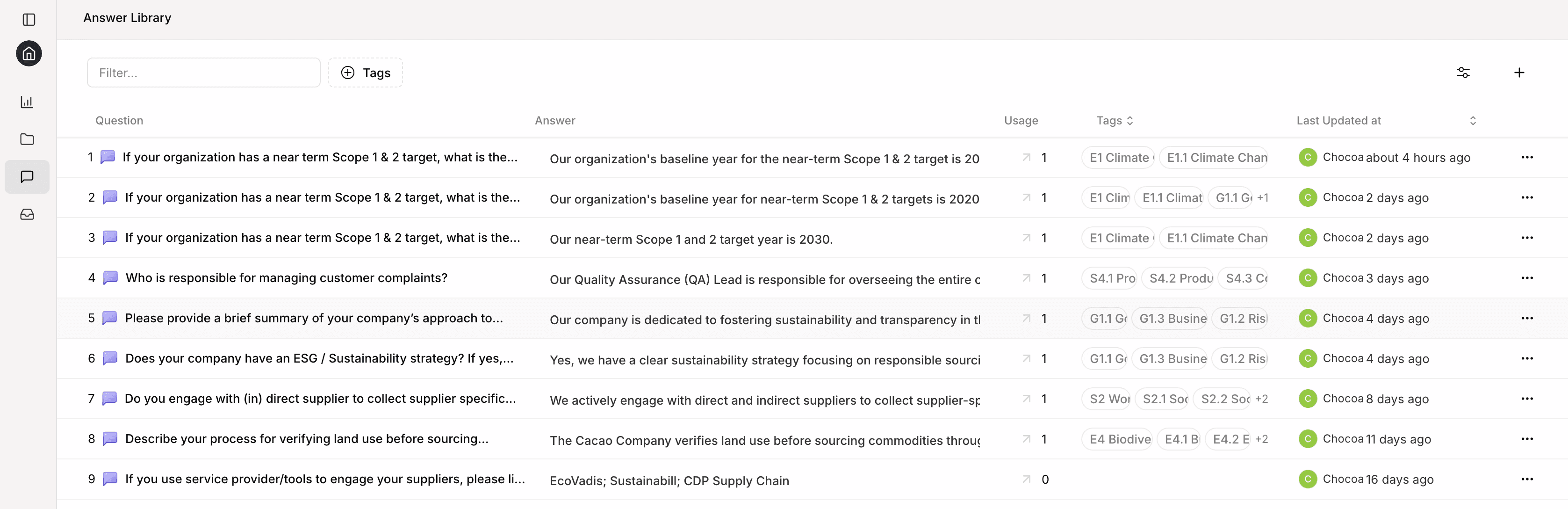
For each topic, document three things: the approved answer text, the source it draws from (the specific policy, certificate, or data point with a file reference), and an expiry signal that tells someone when it needs reviewing. That could be a certificate renewal date, an annual data update, or a process change affecting your allergen controls.
Start by pulling your last five completed questionnaires and listing every question. The overlaps are your first 20 entries.
How to structure it
Organise by topic, not by questionnaire or customer. Allergens in one place. Certifications in one place. Environmental data in one place. When EcoVadis asks about water usage and a retailer asks the same thing three weeks later, you pull from the same entry.
A well-maintained spreadsheet works. Keep the structure as simple as your team will actually maintain.
Who owns what
Assign ownership by domain. Your QA manager owns food safety and certification answers. Your EHS lead owns environmental and health and safety data. Your ESG contact owns ESG-specific content. Each owner reviews their section at a defined frequency, not when a deadline forces them to.
The person coordinating questionnaire responses pulls from the library and fills the format. They are not responsible for keeping answers accurate. That distinction matters.
Handling multiple formats
EcoVadis has structured portal fields and a 55-document limit. A retailer sends an Excel template with drop-down options. A new B2B customer emails a PDF. SEDEX sends a self-assessment questionnaire.
The answer to "do you have a documented allergen management procedure?" is the same regardless of where it is asked. What changes is the container. A yes/no field with an attached PDF in one place, free-text in another, a certificate upload in a third. If your library has the approved text and the source document, you are reformatting, not rewriting.
In short:
Pull your last five questionnaires and list recurring questions
Write one approved answer per topic, linked to its source document
Assign one owner per domain to keep answers current
Set expiry signals for certificates and time-sensitive data
How to set up an approval workflow that holds
In most food and beverage companies, approval for outgoing questionnaires happens over email with no defined flow. The QA or ESG person completes the draft, emails it for review, waits for comments, chases the EHS team for environmental figures, checks with commercial on anything customer-facing. The questionnaire goes out ten days after the deadline.
A functional approval workflow needs four things.
Clear routing: Which sections need review from which person, defined before the questionnaire arrives. Environmental data goes to EHS. Food safety claims go to QA. Anything customer-facing goes to whoever owns that at your company.
Version control: One document, one version, accessible to everyone involved. When something is approved, it is marked as approved, not assumed based on silence.
A defined internal deadline: If the customer deadline is the 15th, your internal review deadline is the 10th. Written down and followed up if it slips.
An audit trail: Who approved which answer, when, based on which version of which document. When a customer questions a response from 18 months ago, you need to show your work.
In short:
Map which sections need sign-off from which role before the next questionnaire arrives
Agree on one shared document as the single working version
Set an internal deadline that gives reviewers a minimum of three to five working days
Record approvals explicitly, not just by email thread
A realistic example: 2 questionnaires, 1 week
A mid-size beverage ingredients manufacturer supplying to several European retail brands receives two questionnaire requests in the same week. An annual EcoVadis reassessment and a 60-question Excel qualification questionnaire from a brand they are in commercial discussions with.
Without a system:
The ESG Officer starts from last year's EcoVadis submission. The 2024 water usage data is not compiled yet, so she emails the facilities manager and waits three days. The allergen management policy referenced last year was updated in Q1 but never filed anywhere accessible.
The Excel questionnaire sits in the Quality Manager's inbox through a production audit week. Both go out late. Three questions in the Excel file were answered differently than the equivalent EcoVadis responses. The new customer's procurement team flags the inconsistency.
With a system:
The allergen management section links to the current approved policy. The environmental data section shows water and energy figures compiled quarterly, with Q4 available and Q1 due next month. The ESG Officer pulls what is available, flags the gap, and completes the EcoVadis reassessment in a day and a half.
The Quality Manager maps 40 of the 60 Excel questions directly to library entries, routes the remaining 20 to the Technical Manager with a four-day internal review deadline. Both go out on time. The allergen answers are identical across both submissions.
What Are the Key Benefits of Supplier Questionnaire Automation for Food Suppliers?
Faster response times → Complete questionnaires in hours instead of days by pulling from pre-approved answers rather than reconstructing responses from memory and scattered files.
Consistent answers across submissions → The same allergen management answer goes to EcoVadis, the retailer Excel template, and the SEDEX self-assessment, eliminating contradictions that trigger customer follow-ups.
Defensible audit trail → Every answer links to its source document, named approver, and approval date—ready to present when a customer or auditor questions a past response.
Reduced dependency on individual knowledge → When the QA manager is on leave during audit season, the team still has access to every approved answer and its source.
Scalability without additional headcount → Handle 2x or 3x the questionnaire volume without proportionally increasing time spent, because most incoming questions map directly to existing library entries.
How Does Manual Response Compare to an Answer Library?
The table below compares the two approaches across the criteria that matter most when managing supplier questionnaires at scale.
Criteria | Manual Process | Reusable Answer Library |
|---|---|---|
Response time | 3–10 working days per questionnaire | Hours to 1–2 days |
Answer consistency | Varies by who drafts; risk of contradictions across submissions | Single approved answer per topic used everywhere |
Audit readiness | Requires digging through email threads to reconstruct who approved what | Each answer links to source document, approver, and date |
Audit readiness | Requires digging through email threads to reconstruct who approved what | Each answer links to source document, approver, and date |
Scalability | Linear: more questionnaires = proportionally more work | Incremental: most new questions map to existing entries |
Knowledge retention | Dependent on specific individuals; lost when staff leave | Documented and accessible regardless of team changes |
Setup effort | None (but ongoing cost is high) | Initial investment of 2–4 days to build first 20 entries |
How to get started: your first steps
Pull your last three questionnaires. List every question. Highlight the ones that appeared more than once. Write one approved answer for each, linked to its source, with a named owner. Do that for your top 20 recurring questions before trying to cover everything.
Define your approval routing now, before the next questionnaire arrives. One shared document, named reviewers, a clear internal deadline.
Set a quarterly reminder to review the library. Expired certificates and outdated policies are the most common reason a good system quietly stops working.
Once this is in place, automation builds on something solid. Matching incoming questions to your library, filling formats, managing approval workflows without email chains. Without it, you are automating chaos.
Conclusion
Supplier questionnaire automation for food suppliers is not a technology problem. It is a knowledge management problem that technology can solve once the foundation is in place.
The teams that handle EcoVadis, SEDEX, retailer, and customer questionnaires efficiently are not working harder or faster than everyone else. They have built a system where the answers already exist, are maintained by the right people, and move through a defined approval process before anything goes out.
If you take one thing from this guide, make it this:
Most questions food suppliers receive are variations of the same 40 to 60 topics. Answer them once, link them to a source, assign an owner, and reuse them everywhere.
A reusable answer library organised by topic replaces the cycle of reconstructing answers from scratch under deadline pressure.
A functional approval workflow requires clear routing, version control, a defined internal deadline, and an explicit audit trail.
Start with your top 20 recurring questions. Build from there.
Automation works when it builds on something solid.
If your team is still rebuilding answers from scratch every time a questionnaire lands, Passionfruit can change that. It works on top of your existing documents and runs the matching, auto-fill, and approval workflow for you. Book a demo and we will show you what it looks like with your actual use case.