A guide for QA and technical teams at food and beverage suppliers. Covers answer libraries, document organisation, approval workflows, and how to build the system without pausing your current process.

Maikel Fontein
9 min
min

There is a version of questionnaire management that most food suppliers know well. A request arrives, someone forwards it to the person who answered it last time, that person finds last year's version in their sent folder, updates what has obviously changed, and sends it back.
It works until it does not: until that person is on holiday, or has left the business, or until a customer's auditor compares this year's answer to last year's and finds they do not quite match.
This guide is for QA and technical teams at food and beverage suppliers handling recurring questionnaires from retailers, brand owners, and certification bodies. It covers the four building blocks of a reliable response system, how to build it without stopping your current workflow, and what good looks like once it is running.
The problem is not that your team cannot answer questionnaires. It is that the knowledge needed to answer them consistently lives in the wrong places: individual inboxes, personal drives, a SharePoint folder that three people have organised differently, a spreadsheet someone built two years ago that may or may not be current.
Why the current approach does not scale
Handling questionnaires one at a time feels manageable when they arrive occasionally. The challenge is that volume rarely stays occasional. Retailers, brand owners, certification bodies, and regulators are all asking for more data, more frequently, and in more formats than they were two or three years ago.
When that volume increases, the cracks in an ad hoc approach become harder to ignore.
Answers become inconsistent across customers: Different people filling in different questionnaires using different document versions means the same question gets different answers. That inconsistency is invisible internally until a customer's auditor puts two submissions side by side.
Institutional knowledge disappears with the person: When that person leaves, everything they knew about approved answers, current documents, and customer preferences goes with them. There is no handover because the system lives in their head.
Response time becomes unpredictable: Without organised answers and documents, every request involves the same cycle of searching, chasing, and compiling. A questionnaire that should take two hours takes two days.
Gaps surface at the worst moment: An expired certification or an outdated answer is not a problem until a questionnaire arrives or an auditor visits. By then it is urgent rather than preventable.
The four building blocks of a supplier response system
A response system that holds up needs four things: a place where approved answers live, organised supporting documents, a clear process for reviewing and approving responses before they go out, and a way to keep everything current between questionnaire cycles.
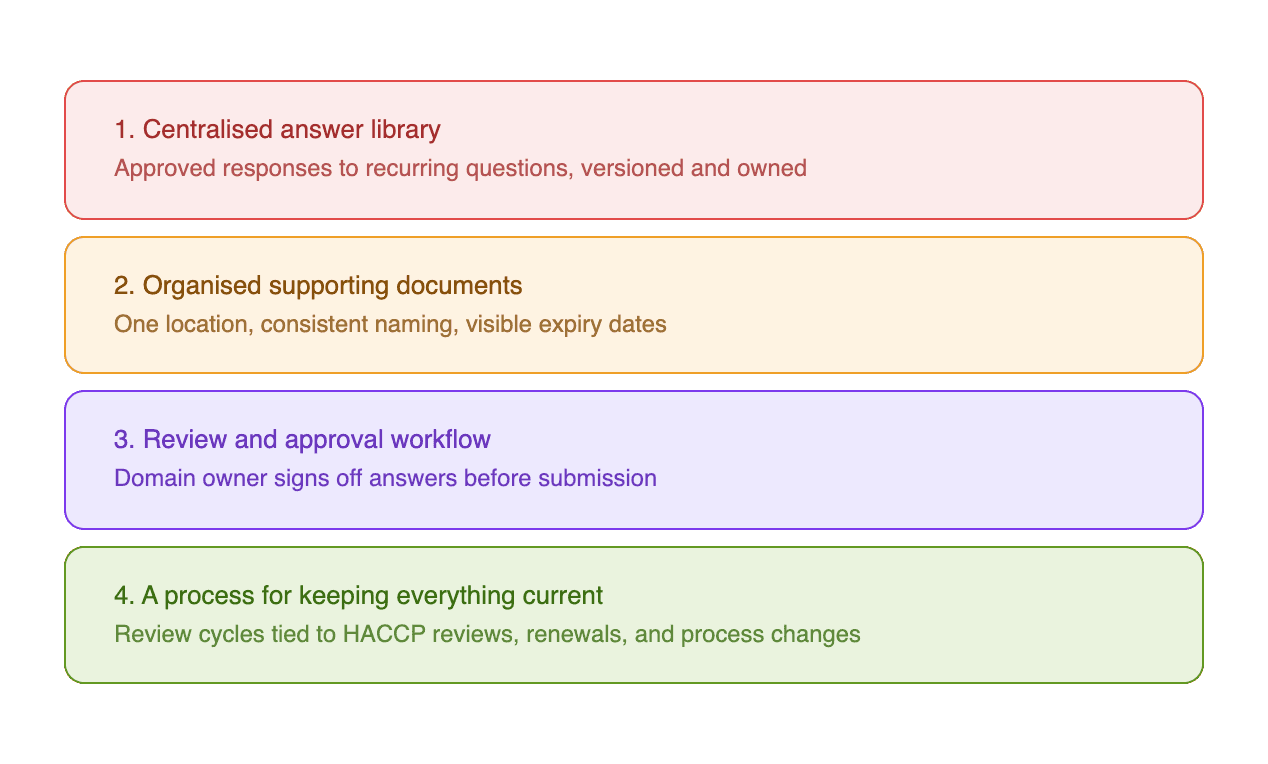
1. A centralised answer library
An answer library is a structured collection of approved responses to the questions your team gets asked repeatedly. Allergen management, HACCP documentation, certifications, traceability, human rights policy, environmental data. The questions change in format and wording depending on who is asking, but the underlying information is the same.
The goal is a verified, approved starting point that your team can adapt for each customer rather than rebuild from scratch. An answer library should give your team a verified starting point to adapt, not a rigid script to copy.
What belongs in it: approved answers to recurring questions, the date each answer was last reviewed, who approved it, and a note of which supporting document it references. Nothing more complex than that to start.
2. Organised supporting documents
Answers reference documents. Certifications, audit reports, allergen declarations, codes of conduct, environmental data. If those documents are scattered across personal drives, email attachments, and SharePoint folders with inconsistent naming, the answer library is only half the system.
The document layer needs three things: a single location where current versions live, clear and consistent file naming so anyone on the team can find what they need without asking, and visibility over expiry dates so a lapsing certification gets flagged before a questionnaire arrives, not after.
This does not require specialist software. A well structured shared folder with a simple expiry tracker alongside it is a credible starting point for most teams.
3. A review and approval workflow
An answer that has not been reviewed by the right person before it goes out is a liability. Not because the person filling in the questionnaire is careless, but because questionnaire responses sit on file and get compared against audit findings, previous submissions, and site observations.
A review workflow does not need to be bureaucratic. For most food suppliers it means one thing: the person with domain knowledge signs off answers in their area before submission. QA signs off food safety and certification answers. ESG or sustainability signs off environmental and human rights answers. Legal or compliance reviews anything that makes a commitment on behalf of the business.
4. A process for keeping everything current
An answer library and document folder that nobody maintains between questionnaire cycles becomes a liability faster than it becomes an asset. Answers reference procedures that have since been updated. Certifications expire. Data figures become outdated.
The simplest way to prevent this is to tie a review cycle to events that already happen in your business: your annual HACCP review, certification renewals, and any significant process or formulation change. Each of these should trigger a check of the answers and documents that reference them, not a full library review every time but a targeted update of what has changed.
Assign ownership. One person or team responsible for maintaining the library is significantly more effective than shared responsibility that in practice means no responsibility.
How to build a supplier response system from scratch without stopping to do it
The part that trips most teams up is knowing where to start, particularly when questionnaires are already arriving and there is no time to build a system before the next deadline.
The answer is to build while you respond, not before.
Start with the questions you get asked most often
Go through the last three to five questionnaires your team has responded to and pull out the questions that appeared in all or most of them. Allergen management, certifications, HACCP, traceability, and supplier code of conduct will appear in almost every one. Write the approved answer for each, get it signed off by the relevant person, and store it somewhere the whole team can access. A shared document with clear headings and a column for last reviewed date is a functional starting point.
Build the document layer alongside it
As you write each answer, identify the document it references and make sure a current version is in a shared location. Note the expiry date of every certification and time-limited document as you go. A simple tracker with document name, owner, expiry date, and a flag for anything expiring within three months gives your team the visibility they need without overcomplicating things.
Define ownership before the first questionnaire goes through the new system
Agree on who owns what before you use the library for a real submission. Which topic areas require sign off from which person or team before an answer goes out. Write it down and share it with everyone involved. Ambiguity over ownership is what causes answers to go out unreviewed.
Run the first few questionnaires as a test
Use the next two or three questionnaires to pressure test what you have built. Where did someone go outside the library to find an answer? Where was a document missing or out of date? Each of those is a gap to close, and closing them under real conditions is faster and more useful than trying to anticipate them in advance.
What a working supplier response system actually gives you
When the system is working, a new questionnaire is a retrieval exercise rather than a research project.
If your team is handling a growing volume of questionnaires and the manual process is starting to show its limits, Passionfruit is built for exactly this workflow. It connects to your existing documents, matches incoming questions to approved answers, and manages the approval process across formats without rebuilding the library each time. Book a demo here to see what that looks like with your actual setup.
The guides below cover specific questionnaire types and question areas in more detail. If you are building your response system from scratch, they are useful reference points for the answers and documents that belong in it.